Monday, February 24, 2020

Do You Want To Be Remembered As Generous?

retired couple on bench
How much money is going to pass to heirs in the next 30 years?  According to Time magazine, the number could reach over $30 trillion.  Yes, that is $30,000,000,000,000. (source)
Today I am going to offer an alternative to leaving money to your kids. One that allows you to live the retirement you deserve while giving your heirs an even better inheritance.
Whenever I create long-term spending plans for my clients, I often hear, “But Dave, I understand you want us to start spending some money as soon as we retire, but we don’t NEED the money. We don’t even know what to do with it. We’ve learned to live frugally over the past forty years. We really don’t need anything else.”
“It’s awesome that you’ve built up those habits,” I’ll usually reply. “That is a big part of why you are in the position that you are in. But if you don’t use your money, someone else will. Maybe the government, maybe your heirs, but you need to seriously think about what this money is FOR.”
No one will ever be as good a steward of your savings as you. Let me say that again for maximum impact:  No one will ever be as good a steward of your savings as YOU. 
You’ve worked for it, you’ve earned it, you appreciate it. You have a more intimate connection to your money than anyone else ever could.
You hear about it all the time. Kids inherit their parent’s money and it causes discord. They waste it. They fight with their siblings. They don’t treat it with the same care and respect as their parents did.
Athletes sign huge contracts, oftentimes straight out of school.  They blow through the money because they weren’t prepared for it.
Many lottery winners say that winning the jackpot was one of the worst things that has ever happened to them. They don’t know how to steward the money because they didn’t earn it.
Of course, you need to do the appropriate planning to ensure you don’t outspend your savings, but once you make sure you are not mortgaging your future, you get to start determining how you want to spend the money, right now.
I want to be very clear.  I am not asking you to become materialistic.  I am merely suggesting that you start living your life with a renewed sense of opportunity.
Which brings me back to your kids and loved ones.  As opposed to leaving them a large lump sum of money at your death, I think there’s a better way.
Give them a little bit each month now. Or put another way, dole out their inheritance a little bit at a time for the next 20 or 30 years.
Of course, we don’t want to enable our children and loved ones— you will have to make that determination.
I’ve noticed giving them specific things, instead of cash money works well (you replace their old car, you start a college fund for grandkids, you help with a down payment, pay rent for a few months for a desperate friend, you help with college loans, you send your grandson to summer camp, etc.).
But members of the Retirement Revolution already know that they are going to spend 5% of their retirement savings each year, starting the first year of their retirement. Some of that money could go to your kids and loved ones now.
The benefits are numerous.
Benefit #1: Your kids are in their 20’s to 40’s right now, which are the most complicated and difficult times in somebody’s financial life. They are having children.They are buying homes.They are starting careers. This is when they need the money. By the time you’re gone, your kids will be in their 60’s and 70’s.
Benefit #2: You are able to see your kids and loved ones actually use and appreciate the money. You get to attend your granddaughter’s piano recital (you paid for the lessons). You get to see the relief on your son’s face when he realizes they are able to replace the car that keeps breaking down.
Benefit #3: You are able to see how your kids and loved ones treat the money. Are they responsible with it? Are they making good financial decisions?  Better yet, you can mentor and guide them on how to better manage their assets. And if they blow your cash?
Well, it’s certainly better you know now.
Benefit #4:  It is tax efficient. Taking out a little money from your retirement accounts each month stretches out the tax liability. It is much better to take a little bit of money out each month versus large lump sums here and there.
While heirs are able to utilize a “stretch IRA,” which can spread out their tax liability over several years, often times I see IRAs cashed out completely.  A $500,000 IRA which is cashed out by your heir, could result in over $150,000 in taxation. (source)
Mega Benefit #5:  You are teaching your kids and loved ones an incredible lesson about generosity. This might be the most powerful benefit of this strategy. Your kids get to see, firsthand, that Mom and Dad are not materialistic, nor are Mom and Dad overly stingy. Mom and Dad place value on what really IS valuable. Relationships. Family. Love and kindness.
If your kids and loved ones see your generosity, they will grow to be generous themselves. Your legacy will last for generations.
Be Blessed,
Dave

Tuesday, February 18, 2020

The Coronavirus and Market Sickness

Many of you have expressed a couple of fears to me recently. Today I am going to answer them to the best of my ability.
Question: Is this terrible virus going to ruin the stock market? 
Answer: No. Unless it turns into a global pandemic that leaves 1% of the surviving population fighting off zombies. 
Some historical perspective:
  • Polio reached its peak in 1949, the market was up 18% on the year.
  • AIDS, 1983, market was up 22% on the year.
  • SARS, 2003, market was up 26% on the year.
  • Avian Flu, 2006, market was up 18% of the year.
  • Swine Flu, 2009, market was up 36% on the year.
  • MERS, 2013, market up 18% on the year.
  • Ebola, 2014, market up 10% of the year.
  • Zika, 2016, market up 17% on the year.
Horrible diseases have no history of destroying investment portfolios.
Question: Dave, the stock market has been going up for ten years. There is no way we can keep this going. A crash HAS to be coming.
Does it? I don’t have a crystal ball, but markets without a crash have lasted much longer than ten years in the past. 1943 through 1972 saw no major corrections. The same goes for 1977 through 1999 (minus a short-lived blip in 1987 that recovered by the end of the year).
Now that we have that out of the way…
Let’s talk about the investment industry. I’m talking about all those companies you see commercials for during football games: T Rowe Price, Franklin Templeton, Oppenheimer, Janus, Putnam and more. There are also smaller funds that specialize in real estate, precious metals, and anything else you could possibly imagine investing in.
This is why I get fired up…
As far as the mutual fund companies go, they employ a pretty nasty trick. I’ve seen it play out time and time again throughout my career. Most mutual fund companies make money through something called an “expense ratio.” It’s a fancy way of saying, “We get a share of your profits because we are so smart that you are going to make more money by investing with us.”
Why do I get mad?
Because, nobody is that smart.
Nobody can time the markets. Nobody can use fancy algorithms to make more money. It has been proven time and time and time again. But many of these funds love to claim that their investments have done better than everyone else’s.
They like to say meaningless things like, “We’ve created value using our bottom up approach which utilizes both technical analysis and sentiment to create a portfolio in which can create alpha and beta and blah blah blah.”
These companies make a TON of money. Some of them charge nearly 2% of the profits. If investors invest a billion dollars into their fund, that is 20 MILLION dollars in fees per year.
But it gets worse. How can a fund company brag about how their funds have outperformed everyone else’s? They kill the bad ones. What does that mean?
Let’s say T Rowe Price creates ABC mutual fund. Investors watch fancy commercials and throw millions of dollars at their feet. Sadly, ABC mutual fund does terribly. It badly under performs everyone else. The investors lose a ton of money. T Rowe Price, in order to keep its sterling record, kills the fund. It closes the fund and transfers client’s money into “similar” accounts. It’s like it never existed.
Because of this tactic, these companies have almost NO risk. If the funds do well, they brag about their brilliance. If the funds suck, they are swept under the rug. But either way, the fund company makes money. The fund company can’t lose. Consumers can certainly lose, but the Putnam’s of the world can’t. I guess that’s why their name is plastered over giant skyscrapers in Boston.
Another example. What about someone who puts a real estate investment together? Everything sounds great going in. You have the opportunity to invest in huge portfolios of properties that kick off interest and capital appreciation. I have no problem with these investments. Some of them are very successful.
But … the sponsoring company makes a ton of money, investors are excited at the prospects of making a killing. And then, just like every business, some of these investing firms are terribly mismanaged.
But does it matter to the guys at the top? They’ve already made their money. The CEO already owns their chalet in Vale. The investors are the ones who lose their money.
This gets me more and more outraged. Why does the consumer have to take all the risk? Why are there no repercussions for this crappy management? It is just how the financial machine works. And you wonder why Wall Street has such a bad reputation.
Now, don’t get me wrong. Clearly, I believe in the power of investing. I prefer low-cost providers that change very minimal fees like Vanguard and Fidelity. They allow you to diversify without using the same tricks referenced above.
And now you know.
Be Blessed,
Dave

Monday, February 10, 2020

The Real Cost of a Free Steak Dinner

The Real Cost of a Free Steak Dinner

Note:  I had another appearance on ABC 7.  If you want to check it out click here https://www.mysuncoast.com/video/2020/02/06/abc-news-roundtable-discussion-february/
(my part starts at 5:00)
The Real Cost of a Free Steak Dinner
Judy retires from her middle management job at a box factory at age 65. While she adored the box industry, it was time for her to move on. She had diligently saved money into her 401k throughout her life, and found herself with a reasonable balance of $500,000.
During her box building career, she didn’t pay all that much attention to the plan. She began saving 10% of her income from the start, and quickly forgot about the deductions from her paycheck. She adjusted her lifestyle, and discovered pretty quickly that her 401k contribution didn’t cramp her style too much.
She had first met with human resources who told her to place her 401k into a diversified portfolio of funds available within the plan. Judy complied and continued on to her day to day work life. During her career, she would glance at her statement once or twice a year. She noticed that sometimes it went up and sometimes it went down, but overall it seemed like she was making money.
Then retirement came. And panic set in. What if her account drops? What if she runs out of money? Maybe the money needs to be somewhere else. Should I put it into something safer? I would like to make some money, but most importantly I don’t want to LOSE any money.
I hear this story every week, and the consequences of this way of thinking can be severe.
Judy receives an invitation in the mail to go to a retirement money seminar (and they were even going to give her a free steak!). The seminar was about making money without the risk of losing any.
Why would Judy give up on an investment program that had made her so much money over the years? Her 401k showed an 8% average annual return over the past thirty years. Why was she trying to reinvent the wheel? Why was she suddenly questioning a portfolio strategy that worked throughout her adult life?
I’m not sure. This is just how humans operate.
There is always a moment of terror when you realize, “I have to live off of this savings for the rest of my life. I need to be more mindful. I need to watch my account every day and lose sleep when it goes down.”
So Judy goes to a “Free Steak Seminar” and learns about all the wonderful investment options available to her. Before she knows it she is sitting in front of salespeople hell bent on getting her out of those terrible stocks and bonds and put the money somewhere better.
If anyone ever tells you that you can make money when the markets go up and not lose money when they go down — sit back and take a breath. Does that really make sense? What investment company would do that?
So Judy meets with some very nice gentlemen and decides to put her money into an equity indexed annuity. I’m not one to bash other products. Everyone has different needs and different risk tolerances.
But … these things are terrible.
If the market goes up you get a tiny amount of the “up,” and if it goes down you lose nothing. Most of these contracts lock you into ten years. If you want to make a couple percentage points per year, just throw the money into a CD.
I see this all the time. People switch from a diversified portfolio of stocks and bonds, and suddenly get sucked into a new product. Salesmen are very aware of “newly retired” financial fear.
Judy is now in a worse position. Considering this new investment only returns around 2% per year, the reduced income results in a reduced monthly interest check.
In order to join the Retirement Revolution you have to come to terms with this simple fact: You need to invest your money in stocks and bonds. Period. You have to put your trust into something that you don’t entirely understand. You have to deal with the ups and downs. But without the power of these kinds of investments none of this works.
I propose retirees spend “the money the money is making.” This is the absolute core of my message. I suggest using 5% per year. Why? Because if a diversified portfolio of stocks and bonds do not return 5% on average over time it is almost historically unprecedented.
“Spending the money that the money is making” allows you to know exactly how much money you can spend each month. No more and no less. Isn’t that an incredible burden lifted from your shoulders? No more guessing. No more walking around with your hands in the air thinking, “I hope this works; I hope I don’t run out of money.”
Don’t try to reinvent the wheel. You made money in your 401k while working, and you will make money once you’re retired. Don’t give into the fear tactics all around you. Don’t be like Judy who had to take fewer vacations and spoil her grandkids less. Her fear of running out of money actually increased the chances that she would. It is ironic and sad and I witness it constantly.
Be Blessed,
Dave

Monday, February 3, 2020

Can You Get a Paycheck Without Working?

When I take on new clients there are certain rules that I ask you to follow.  One of the most important rules is: As soon as you retire, each month you take an income check from your retirement and investment accounts: whether you need it or not.
Here’s a quick example:
Mr. and Mrs. Smith retire with $500,000 in savings.  We determine that by utilizing a diversified portfolio of stocks and bonds (with at least half of the money in stocks), it would allow them to withdraw $25,000 a year from their savings.  Looking over 200 years of economic history, this is a sustainable and reasonable withdrawal amount.
Now, do Mr. and Mrs. Smith dip into their account whenever they need some money, making sure they don’t go over the $25,000?  No.
Do Mr. and Mrs. Smith take all $25,000 at once at the beginning of the year?  No.
There is definitely a psychology to retirement spending and I’ve learned, over the past 18 years, that neither of these approaches works particularly well.
If you only dip into your account when you “need to” most people find it to be a painful experience. Remember, you are children of depression era parents. To many of you, withdrawing money from your retirement savings can conjure up thoughts like, “I hope this isn’t a mistake, I hope I don’t run out of money.  This just feels so irresponsible.  This money doesn’t even really belong to me, it belongs to retirement.”
What about taking the $25,000 all at once?  While this is a better option than above, I’ve found that generally speaking, human beings live their financial lives on a monthly basis.  Most, if not all of your bills are due monthly. You’ve been getting paid monthly or bi-weekly your entire life. It can be difficult to budget a $25,000 lump sum to last the entire year.
So after years of in-the-trenches financial planning experience, I’ve determined the best strategy, by far, is to receive income checks on a monthly basis.  So in the example above, Mr. and Mrs. Smith take their $25,000 over 12 months (or $2083/mo).
This not only allows you to know exactly how much money you can spend in any given month, but it also takes away the pain of withdrawing money from your retirement savings “as needed.”  For whatever reason, when human beings see their checking account growing as the investment income checks roll in each month, they treat that money differently than if it was still in their retirement savings accounts.
Think about this for a second.  If you had $500,000 in your retirement savings and that account grew to $525,000 during the year, you might say to yourself, “Oh, that’s nice.  At least the money is growing.” And then you go about your day and probably not think much about it.
But if that $25,000 ended up in your checking account, you might say, “Wow!  This is awesome. Instead of me working, my money is working for me. It’s like I’m getting a ‘paycheck’ for doing nothing!  How am I going to spend my money to make my retirement more awesome.”
As you can see, these are radically different experiences of exactly the same investment results.
And don’t forget, the central tenet of the Retirement Revolution is you need to spend the money you receive.  You are not going to end up like the majority of Americans who are dying with significantly more money than they’ve ever had before in their lives. (source)
You are going to live an empowered and fulfilling retirement armed with the knowledge that you are spending exactly the right balance between too little and too much.
So if, as you are receiving your monthly investment income check, you find yourself saying, “I had better stick this money in the bank and save as much as I can.  I sure don’t want to outlive my money.” Stop! Spend. The. Money. I’m not telling you to become materialistic. I’m not telling you to buy stuff you don’t really want or need.  I’m telling you to live your life with a sense of opportunity and openness to reinventing yourself during your retired years.
So get those checks rolling in, spend the money, and find comfort in the fact that you have a plan in place that has stood the test of time.
Be Blessed,
Dave


Monday, January 27, 2020

Taxes Explained

Tax Strategies
Tax Time is rolling around, which confuses many of my clients.  There is a lot of daunting terminology out there. I’m going to stick with stuff you actually need to know.
Disclosure: I’m not a CPA but I’ve learned some things through the years. Get ready to learn.
1099-MISC: A “1099-MISC” is for work you did as an independent worker or freelancer.
1099-INT:  This reports interest income you’ve received from savings/CD/money market accounts.  It also includes any interest you receive from bonds outside a retirement account. This income is taxed at your federal income tax bracket.
1099-DIV:  If you are receiving dividends from an account outside a retirement account you must pay taxes.  These tax rates can be more favorably.
As an aside, most people believe the long term capital gains rate to be 15%.  It often times isn’t.  If you are married and show less than $80,000 in income, the tax rate for long term capital gains is zero.  If you add your social security plus your IRA withdrawals plus the capital gains and it totals less than $80,000- no capital gains tax.
1099-R:  This is probably the most important forms to most of my clients. It reports how much money you distributed from your retirement accounts (IRA, 401k, etc.).  It does not apply to Roth IRA’s.
Required Minimum Distributions (RMD’s):  I get a tremendous number of questions on this subject.  The IRS just raised the age at which time you need to start withdrawing money from your retirement accounts (from 70.5 to 72). The amount you need to remove depends on your age.  At 72 the amount is around 4%.  Do you need to worry about RMD’s?  My clients don’t.  By taking the 5% of their portfolio, they naturally satisfy the RMD.
Stretch IRA:  When you pass your retirement accounts on to your heirs there is no need for them to cash in the account right away.  This would trigger massive taxation.  The IRS now gives them 10 years to spread the tax burden over time.
Standard deduction:  The vast majority of you will utilize the standard deduction.  If you are married you can deduct $24,800 from your income. Meaning- if you income is $100,000, you only have to pay taxes on $75,200 after the standard deduction.  If you are single the number is $12,400.
The only time you would not use the standard deduction is in situations where you have several other deductions (mortgage interest, charitable giving, etc.). These are called itemized deductions. About 90% of the U.S. population just use the standard deduction.
For example, if your mortgage interest is $15,000 you do not get to deduct it from your taxes, as it is less than the standard deduction.
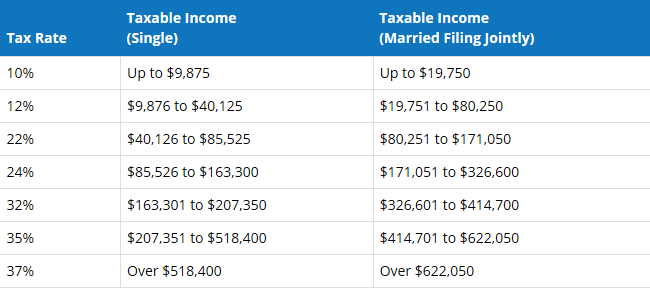
Progressive Taxation:  I find some people can have difficulty with this concept.  Below are the current tax rates:
Image result for tax brackets 2020
This is where the confusion comes in.  Looking at the table above, some people believe if they make one dollar over the 12% threshold they must pay 22% income tax on all their income.  This is not how this works.  Let’s say you are single and make $85,526.
The first $9,875 is taxed at 10%.  From $9,875 to $40,125 you pay 12%.  From $40,126 to $85,525 you pay 22%. So if you are one dollar over, you would only pay 24% on that one dollar.
Cost Basis:  First look at how much you paid for a stock, bond, or real estate property.  Then look at the selling price. You must pay taxes between the cost basis and the selling price.  This does not apply to retirement accounts.
Estate Tax:  In Florida this only applies to people worth over $10 million dollars.  If you have that much please call for an appointment.
Gift Tax:  This is also extremely misunderstood.  Unless you are worth millions, you can gift as much as you want.  The $15,000 rule does not apply. Give freely. The recipient does not have to pay taxes on it.
In addition, I always talk about how retirees are surprised at how little they pay in taxes once retired.  I’m going to include the chart below so that you do a quick estimate of your monthly tax liability based on your monthly income.
Income is basically derived from Social Security + Pensions + 401k/IRA withdrawals.  Of course this is not exact, but you get the idea.
MarriedMarriedSingleSingle
Monthly IncomeMonthly TaxMonthly IncomeMonthly Tax
0-5k$00-3K$0
5-6k$1503-4K$150
6-7k$4004-5k$350
7-8k$6505-6k$550
8-9k$8506-7k$750
9-10k$11007-8k$1000
10-11k$13008-9k$1300
11k+Congratulations!10k+Good Work!
Be Blessed,
Dave
P.S.  Please keep sharing.  I’ve had a lot of new subscribers.  Keep it up!  Facebook seems to work best.

Tuesday, January 21, 2020

Market Bubble Set to Burst

Market Stressed Trader - Dave Kennon
Market Bubble Set to Burst
Did this headline scare you?  Did it make you want to read this article?  Not to worry, there is no reason to think the Dow is going into a free-fall.  I made up the title. I’m really sorry I spooked you. I’m just trying to make a point.
Recently I have seen more scary headlines than usual concerning the markets. I’ve found myself literally yelling out loud, “How are people even allowed to publish this stuff- let alone why it is showing up at the top of my news feed?!”
This is not a victim-less crime.  I can’t tell you how many people like you let these headlines force them into making emotionally charged investment decisions.
Emotion + Investment Decisions = Not a Good Idea
It also causes untold worry and stress on the millions of readers who are depending on stocks and bonds to fund their retirement years.
I did some digging and re-read articles from 2018.  The results prove my point. It’s kind of funny in a sad way.
So let’s take a step back into 2018 and see what the prognosticators were prognosticating.
We’ll start with an article from Marketwatch.com titled:
Why This Drives Me Nuts:
Nobody knows when the stock market is going to go up or down.  I can’t state this any more clearly: There is zero academic evidence that there has ever been a single person who could consistently predict when the stock market is going up or down.
Morgan Stanley is a big name in the investment industry.  Using their name makes the article even scarier, because it sounds like it is coming from a reputable source.
The website is using a “click-bait” strategy.  The owners of the website do whatever it takes for you to visit, so that they can display ads, so they can make money.
Could stocks go down?  Sure. It is a natural part of the markets.  But it has no bearing on your long-term financial security.  It is about time IN the market, not TIMING the markets.
By the way, did the stock market “correct” itself back in 2018-19?  No. It went up 30% in 2019. I hope you didn’t read that article and sell your portfolio.  If so, you may want to email the author and ask for your money back.
This is the problem.  News outlets and writers take no risk when writing this stuff.  If they’re wrong, who cares? At least they found content to fill the pages.  If they’re right? Now they tout their incredible research skills.
Let’s move on to the second article.  Also from Marketwatch.com. Also from 2018.
Why This Drives Me Nuts:
Anytime the word “doom” is in the title of an article, you may want to take it with a grain of salt.
The “prophet of doom” runs a mutual fund.  He gets paid based on how many people buy his mutual fund.  The more he can get his name in the news, the more attention he gets, and the more investors he recruits.
The “prophet of doom” has been predicting a historic crash every year for the past 18 years.   He was “right” two times, and now he is “famous” for being a “prophet” because he predicted the corrections in 2001 and 2008.  Really?!
If you followed this guys advice, out of terror, you might have buried your money in a safe in your backyard under concrete.  In this scenario, $100,000 in 2000, would be $100,000 in 2018. Do you know how much money you lost out on? $100,000 invested in the year 2000 would be worth $323,000 today. (source)
The article also uses lots of technical looking charts and graphs- all of which have been proven to be completely ineffective at predicting the stock market.  But to the uninformed reader, they appear to give a lot of credibility to the idea.
He is predicting that the Dow will drop 69%.  If the Dow dropped 69% it would spur on another Great Depression!  Really?!?!?!
Ok, I better wrap this up before I get too fired up.
Online newspapers sell advertising.  The more people who read the article, the more money the newspaper makes.  Newspapers will write any headline possible to get your attention. Unfortunately, the media learned long ago that doom and gloom gets a lot more “clicks” than sensible financial news coverage.
Ignore.  These. Articles.
Be Blessed,
Dave

Monday, January 13, 2020

My Life in 5 Minutes

My Life in 5 Minutes

Somebody remarked me this week, “Dave, I like the articles you write because you just say it like it is.  You don’t get all fancy or wordy.”
It reminded me.  I don’t like to read stuff that’s overly wordy either.  It seems that many articles I see contain 90% filler and 10% information.  So this week I am going to take things to a whole new level. Below you will find several concepts that I’ve talked about over the past few years- in as few words as possible.  I’m trying to take my entire planning philosophy and boiling it down into a five-minute read. Are you ready? Let’s go!
1. Nearly one-third of the country die with more money than ever.  This implies that many retired Americans are underliving and underspending.  Sound crazy? Just look at the data.
2. The media is your worst enemy.  With all the doom and gloom in regards to the economy and social programs, it is easy to fall into the trap of saying, “Oh my!  I might end up living in a van in the Walmart parking lot.” These fear tactics are completely twisting the reality of most retirees.  While, obviously, there is a portion in the country who find themselves in challenging situations, I would estimate two-thirds of you are in better shape than you realize.
3. Everyone is terrified of running out of money.  Everyone. I don’t care if you have $100,000 in the bank or two million.  I’ve met with literally thousands of retirees. This fear controls almost all financial decisions in your life (but it doesn’t have to).
4. Over the past eighteen years I’ve looked under every rock for a solution to the question:  Where the heck do I put my money once I retire? The conclusion I’ve found is now abundantly clear:  A diversified and balanced portfolio of stocks and bonds. Period. End of story.
5. On that note.  Stocks are remarkably powerful.  Over any long period of time (10-20 years), they’ve basically always returned around ten percent.
6. Taxes are far lower in retirement than while working.  If you are retired and married, bringing in $5000/mo or less, you will pay no income taxes.  If you are single, the number is $3000/mo. This doesn’t apply to those still working part time.
7. Inflation is not going to ruin you.  Social Security increases lock-step with the rate of inflation (if inflation grows by 2%, your Social Security check increases by 2%).  In addition, spending naturally goes down as you age. From your late 50’s to your early 80s, spending goes down by 40%.
8. If you are invested in a diversified portfolio of stocks and bonds, it is reasonable to spend 5% of the original account value each year. If you retire with $100,000 you can spend $400 a month.
9. Retirement is not all about golf and sipping margaritas by the pool.  Once you retire you need to find purpose.  Make sure you plan ahead of time. Whether you volunteer, start a new business, help raise the grandkids, or serve your church- do not fall into the trap of complacency.  Purposeless inactivity is literally bad for you health.
10. Give with a warm hand.  Generosity is contagious. Inheritance is overrated.  It is far better to help your loved ones and others in need, while alive, than once you’re gone.
11. Presidential elections have no long-term effect on the stock market.
12. Your friends have less money than you think.
13. Don’t buy into the hype.  No one on the planet knows if the stock market is going to go up or down this year.  Not Warren Buffett, not Jim Cramer, no one.
14. The most important factor once retired is not your savings, 401k or social security.  It is your budget.
15. Social Security is not going broke.  It just isn’t. Get it out of your mind.  I can go into great detail of why- but that is for another day.
Whew.  That was fun.  I hope you learned something.
Now go out there, grab the tiger by the tail, and proclaim, “I’m not going to live in fear.  I’m educated and ready to go!”
Dave