Monday, July 11, 2022

Inflation Will Destroy the World


 COMMENTS

Inflation Will Destroy the World


You may have heard the news.  The first half of this year had the worst market returns since 1970. That’s over 50 years!  Let’s take a look at how statistics can lie.  

In 1970, if you look at the whole year, the markets went up 3.56%.  That’s right.  The market completely recovered and then some by the end of the year. Don’t let the news trick you by twisting around data and history.

Does inflation have a direct correlation with lower stock market returns?  No.  Inflation does not mean the markets will go down.  The markets are fundamentally unknowable.  I know it is frustrating, but stock and bonds and illogical and unpredictable.  

So much of today’s market fluctuations are based on fear, greed, and speculation.  Companies are not showing lower profits.  Bonds are not defaulting on loans.  It’s all a game to see who can make the most money by guessing at market returns.  Long-term returns will remain the same.

See below for some perspective on the correlation between inflation and stock market returns.

Inflation  S&P Return  Year
14.4%         5.2%        1947
13.6%         31.7%      1980
11.3%         18.5%      1979
11.1%         -25.9%     1974
10.9%        19.2%       1942
10.3%        -4.7%        1981
9.1%          37.0%       1975
8.5%          -8.4%        1946
7.9%          23.7%        1951
7.7%          5.7%          1948
7.6%          6.5%          1978
6.5%         – 7.0%         1977
6.2%         -14.3%        1973
6.1%         20.4%         1982
6.0%         25.1%         1943
5.8%         3.6%           1970
5.7%         23.8%         1976

As you might notice:  There is no correlation.

What is up with all this recession talk?!  Sure the markets are having a tough time, and while the markets may drop even more, it has no bearing on your life.

You cannot listen to any news source lately without hearing warnings of a pending recession.  I’ve had several people in my office recently scared to death.

It is completely out of control.

Remember that the news will report on anything that will get and hold your attention. Stock market pullback? Big news!  Network executives are thrilled. It’s great for ratings, but it is terrible for you.

Why? It gives you the faulty perception that anyone and I mean anyone, can predict what will happen over the next days, months, and years.

Stay the course.  In a couple of years you won’t even remember this happened.

I’m sorry this article is so short this week.  My daughter is celebrating her Sweet 16, Grammy is coming into town, and we are very very busy.

Be Blessed,

Dave

Saturday, July 9, 2022

 I became a National Social Security Advisor to help equip pre-retirees with the understanding of how Social Security Benefits can be used to their maximum.

Everyone is unique and in different situations in life. Some are singles, many married or divorced and some even widowed. No matter your situation now or during retirement, learn the facts concerning your Social Security Benefits in a comprehensive relaxed setting, downtown Sarasota.


This FREE Social Security Timing Class is brought to you by National Social Security Advisor David Kennon in the PentHouse suite of Kane Plaza (held monthly). 

Our classes are strictly educational.

Things You Will Learn:

1. How your Full Retirement Age (FRA) affects your benefit payout.
2. What happens if your spouse is still working.
3. What if you still are or want to work part-time while claiming Social Security?
4. What if you are divorced or widowed?
5. How to maximize your Social Security benefits.
6. How inflation affects your benefits.
7. And much more!

Reservations are Required! Secure your seat at SarasotaClass.com

FREQUENTLY ASKED QUESTIONS:
Is there a cost to attend? No, there is no cost to attend.
Do I need to bring anything? No, just your smiling face.
Am I being pitched or sold anything? No. Our classes are for educational purposes only. The most common feedback we receive is how nice it is to attend a truly educational workshop with no pressure.

For more information go to SarasotaClass.com
Dates may update regularly

Tuesday, June 21, 2022

Temporary Losses and Permanent Gains


Temporary Losses and Permanent Gains

Family Update

We came back from Pittsburgh on Monday. I’m glad to be working in my office again instead of remotely. When we got back our puppy went completely nuts. I have never seen an animal express that kind of joy before. Every year we also measure all the kids. My middle son, Alex, just turned 12 and he grew more inches than anyone else. I would also like to point out that my wife is incredibly patient and kind. Do you want to know what it looks like to move a six-person family?


Should I Sell My Stocks?

Clearly, with the current economic situation, I am here to be the voice of reason. First of all, I want you to say to yourself (out loud if you so choose):  Markets temporarily go down and permanently go up.

As you can imagine, I’m getting the same questions over and over again. Here are the answers to some common ones:

Common Question #1

“Dave, I’m taking money from my portfolio each month. Do I need to stop that disbursement since the market is down?”

No. Remember, we are assuming an average of 5%. Did you get more money last year when the market was skyrocketing? No. You get what a diversified portfolio has averaged.

Common Question #2

This time is different. What do we do Dave?

This time isn’t different. I wrote an article about this about a month ago if you need to refresh your memory.

Common Question #3

“Do I need to worry?”

No.  This volatility has zero bearing on your long-term financial future.

Common Question #4

I’m too old to invest. This is all I have. What do I do?

It is very easy to remember when the stock market goes down, but most people do not remember that the Dow Jones was 21,000 during Covid and now it is at 30,000.

If you give into the fear, and put all of your money in cash, you are actually increasing your chances of running out of money. The most important variable when it comes to retirement planning is the fact that your money keeps working for you.

Common Question #5

“Should I get more conservative with my investments until this all blows over?”

No.

I’m going to give you cold, hard data that will debunk the concept that timing the markets in this situation might help.

I want you to know that I am not remotely worried. I’ve been through this before and it always ends the same way. Betting against innovation and progress is ALWAYS a mistake.

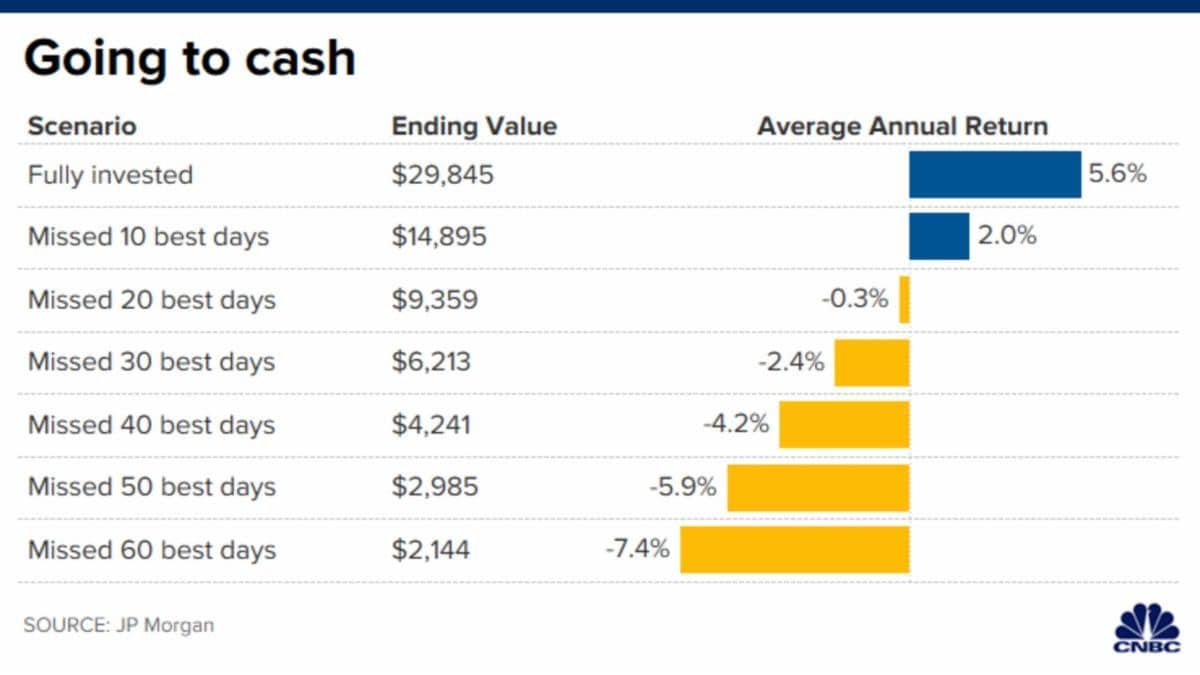
Here is a profoundly important chart.


What does this mean?

The chart is pointing out that, from 2000-2020, the stock market had averaged 5.6% per year. But if you missed the 10 best days, you would have lost two-thirds of the overall profits.

Think about that! Out of 7,300 days, missing the best ten, you decimated your long-term returns.

You cannot time the market.

I often hear, “I’m going to wait until things settle down.” When is that exactly? After the market has two amazing days, or three? Oops, you just messed up your whole life-long investment strategy.

You can do this!

Be Blessed,

Dave

Monday, June 13, 2022

Joe and Frank: The Tale of Two Savers


Joe and Frank: The Tale of Two Savers

Family Update

We are in Pittsburgh visiting Grammy and Pop. My four kids look forward to this trip every year. We always come up for one of the kid’s birthdays. This year Alex turned twelve. He loves games so we played:

Shuffleboard

Croquet

Ping pong

Playing cards (spades and hearts)

and much much more

For some reason, I can’t figure out how to upload pictures on this computer. Extra pictures of pets and kiddos next week!


While the story below is fictional, it is based on real scenarios I’ve witnessed during my career.

Joe and Frank both retired 25 years ago, 1993. They were both 65, both married, and both had $1,000,000 in savings. Their stories are remarkably similar in the beginning, except for one big difference — Joe made his decisions based on fear, and Frank based his decisions on realistic expectations.

When Joe retired he went to his local bank and said, “I’m retired now, I can’t afford to lose anything. I want to put all my money in a money market account.” In 1993 money markets were paying an average of 3.9% and Joe felt pretty good about that.

Of course, there was no way he could have known that interest rates would drop so low later on in his retired years.

As the market fluctuated, Joe became more and more fearful. “I don’t want to spend any of this money unless I HAVE to. I know Ellie wants a new kitchen, and I would love to visit the grandkids in Rhode Island, but … I’m not making a salary anymore. I have to be very careful with this.”

Over the next 30 years Joe scrimped and saved. He never once needed to take more than a few thousand dollars out of savings. When he died in 2016, there was quite a bit of money still there. Over 25 years of compounding interest inside the money market account had turned his $1,000,000 into $1,800,000.

Joe and Ellie never made the trip to visit the grandkids. Ellie never got her updated kitchen. In fact, they spent most of their retirement trying to live with less and less.

They never ran out of money, but they also never got to really enjoy their retirement.

Now Frank looked at things differently.

“I’ve worked my whole life so that I could enjoy the fruits of my labor in retirement. We are going to put a pool in the backyard. Both Mary and I love to swim and it will keep us active and healthy. We are going to travel as much as we can for as long as we are healthy enough to do so.”

Frank went to a local advisor and said, “I want my money to keep working for me since I am no longer working and making a salary.”

The advisor suggested a diversified portfolio of stocks and bonds.

So Frank put 60% of his savings into stocks and 40% into bonds — a very common portfolio asset mix.

Frank then started taking out $50,000 a year from his portfolio, or 5% of the original value. His friends called him crazy. “You are too old for investing,” they’d say. “You are going to run out of money!”

But Frank knew he was reasonably safe to spend the money his investments were earning.

Frank spent the $50,000 each year on things that made him and his wife Mary happy. They spent an entire month in Australia. They traveled up north for each of their grandkids’ birthdays. Frank even bought himself a 1969 cherry-red Chevy Camaro.

When Frank died in 2021, his kids gathered and looked at his investment statement. He had taken out $1,250,000 over those 25 years. Were his kids angry or resentful? Not at all. They remembered all the crazy adventures he and Mom had with that money. All the family vacations, the special occasions made more special by their presence. They also remembered the times they’d needed help and had been able to turn to their parents.

How much money did Frank have left over in 2021?

At Frank’s death a little over $4,725,890. That is not a typo. He started with $1,000,000, took out $1,750,000, and ended up with over four times the amount he started with. He also ended up with more than twice as much as Joe.

The Moral of the Story: Being “safe” with your money may not actually be safe at all!

A well-diversified and balanced portfolio of stocks and bonds is a powerful wealth creation tool. You may be able to spend more of your retirement savings than you realize, and enjoy more of your retirement years.

Please pass this story on to friends and family. It might just possibly change someone’s life.

Be Blessed!

Dave

Monday, June 6, 2022

The Dangers of Downsizing


The Dangers of Downsizing


Family Update 

School is over and it’s time for a trip to Pittsburgh to see Grammy and Pop. There is so much to do up there, and the weather is so nice and cool. All four of them, at one time or another, have expressed an interest to live up north. They figure you get to see the changing seasons and the beautiful snow. 

What they don’t understand is that snow is only pretty for a day, and then it turns into a gray, gross sludge. Winter lasts from November until about April in Pittsburgh. I think they would change their tune if spend a year there.  


A lot of Baby Boomers find that the majority of their assets is equity in their home. In conversations with me, they say something to the effect of, “Dave, a big part of our retirement plan is to downsize our house.”

Let’s think about that idea for a second.

Let’s assume:

  • You own a single-family house in the area.
  • You enjoy living there. You’ve made it your home.
  • You decide to downsize in order to fund your retirement and lower your budget.

Ok. So now let’s think about your options. Where are you going to move?

  • A smaller (probably worse) single family home
  • A townhouse
  • A condo
  • A manufactured home

That’s not to say there aren’t situations where downsizing makes sense. There are. Keep reading and we’ll get there.

But first, let’s assume your house has been your sanctuary for most of your adult life. You love it, but you’re considering downsizing to have more money for retirement.

Downsizing for savings is often a daydream, not reality.

For example, let’s say you own a $500,000 single-family home with no mortgage.

You decide to move into a townhouse. A decent townhouse will cost you $400,000 at an absolute minimum. Don’t forget about the HOA fees. That could be hundreds a month. And don’t forget about moving costs, paying the realtor a commission, redecorating or making minor repairs ….

You now own a $400,000 townhouse (which maybe you don’t like as much as your last home), paying a few hundred a month in HOA fees.

Sure, you have $80,000 in the bank (after fees, commissions, closing costs, etc). That $80,000 can produce about $300 a month in dividends and interest. You are almost exactly where you started. Maybe you are saving a couple hundred dollars a month.

Is it really worth it?

Another example: Let’s say you own a $500,000 single-family home with a $200,000 mortgage. You are paying $1,300 a month on the mortgage which you’ve had for over ten years.

You decide to move into a $300,000 condo. No more mortgage, no more expenses.

Actually, that’s not entirely true. Barring some kind of real estate miracle, a $300,000 condo is not going to be as nice as the house you just sold.

Now come the HOA fees. Condos are notorious for high fees, which can change at the drop of a hat. Also, don’t forget, you may get a letter from the condo board that says: “We decided to replace the roof and we’re going to charge you an assessment of $8,000.”

But now you have no mortgage! That saves you $1,300 a month in mortgage payments (minus the HOA of $300). So you now live in a condo that you don’t like as much as your house which needs a ton of work and you have an extra $1,000/mo.

Is it really worth it?

When does it make sense to downsize?

Here are some examples where it might make sense to downsize.

Your current home is too big.

The kids moved out and you are left with a 3,000-square-foot home with a big yard. Downsizing in this situation often makes sense. While you might not save a ton of money, maintenance-free smaller townhomes can be very attractive.

You plan on a major downsizing.

Moving from a $400,000 home to a $100,000 manufactured home will create a significant difference in budget and spending needs going forward. Few people like this option.

You have the opportunity to move in with a family member.

This can be especially attractive if your child or relative has an apartment attached to their home, or a mother-in-law suite. This is a fantastic way to lower expenses and increase cash in the bank (not to mention bringing your family together).

You have no other retirement assets.

This is not ideal, and not the situation for most retirees. But, for those folks facing this reality, selling their home and downsizing to a much smaller space can help them live comfortably throughout their retirement.

So, before you think that downsizing could fix all your retirement worries, really consider the long-term financial ramifications. Do the math, consider the emotional consequences of moving, and move ahead with caution.

Be Blessed,

Dave

Tuesday, May 31, 2022

Buying a CD with a -7% Interest Rate


Buying a CD with a -7% Interest Rate

Family Update


My wife grew up around family that loves fishing.  Her oldest brother, in particular, would fish all day every day if he could. 

We found a fishing good spot on the shore, and the family has been trying to catch a keeper ever since.  Up to this point we’ve caught mangrove snapper, snook, catfish, and sheepshead.  In my opinion, the snapper is the tastiest.   

Below you can see Grandpa helping the kids bait hooks and release fish.  He barely has any time to fish himself.  Lines keep getting tangled and hooks get stuck on rocks underwater.  

You might also notice a pelican waiting patiently.


Dawn was a nurse for an OBGYN doctor. The stock market keeps going down, she thought. It seems like every time I put my money into my 401k it just disappears. I had $100,000 in the account, then I added $5,000 and now it is worth $95,000. Why would I keep putting money toward retirement when all my contributions get lost in the market? I’m going to stop putting money into my 401k.  

Dave’s Take: Huge mistake! If anything she should be increasing her contributions. Nobody can predict the movements of the market but we certainly are not at the top of the market. Keep saving! You’re buying low. 

Next up . . .  

Jack, a retired engineer, was studying his portfolio. These accounts have lost $50,000 this year. This is all we have. If this portfolio runs out, I don’t know what I would do. I am going to cash out and wait for the markets to stabilize. It feels like if I don’t do something I’m going to lose all of my money. 

With his money on the sidelines, Jack very quickly realized how hard it is to re-invest money once you’ve sold low. Jack watched as the markets went lower. He felt pretty smart. But then they started creeping back up.  

Not quite yet, Jack thought to himself. The economy still seems fragile. The markets may have rebounded back to their original levels, but at least I didn’t lose any money. I guess I missed out on all those gains, but there is no way I’m going to invest now. The market is at an all-time high. I’ll wait until the market goes down again… 

Dave’s Take: Many people fall into the same trap as Jack at some point in their investing lives. They sell low and wait for things to “settle.” Before they know it, it is a year later, and the markets have fully rebounded and you’re still on the sidelines.  

Next up . . .  

Bobby was incredibly stressed about his investments. He didn’t really have anyone around to help him navigate the choppy waters. As soon as the account was down 20% he threw in the towel. He thought, I am done with this. I swear I’m never going to invest again. I’m too old anyway. So Bobby went ahead and put his money in CDs. 

Dave’s Take: Bobby’s financial situation is going to get crushed by inflation. Remember, you can temporarily lose money in the stock market, but by putting your money in low-interest-bearing instruments, you are guaranteed to lose purchasing power.  

Next up…

 George saw his account values going down and it was making him sick. One day he heard on the radio about software that would help him day trade. It proclaimed, “CenterPoint Securities is a great place to trade because it offers direct access to all the assets you could want. The platform offers several helpful features like: advanced charting, level 2 order routing, short inventory access, capacity for advanced and high-volume traders, built-in scanners, custom alerts, and advanced order entry.” 

George, while having no idea what all those words meant, was excited and, after paying the hefty subscription fee, started trading stocks several times a day. Not only did he trigger all kinds of unnecessary taxation, but his money went down even faster.

 I thought these guys knew how to make money in any market conditions, George grumbled.  

Dave’s Take: All of these software programs are garbage.  All of them.  

Next up . . . 

Joey and Jan had been looking forward to a trip to Europe. COVID has really put a damper on their plans. By the time travel started up again, Joey and Jan watched their portfolios falter. “We can’t take this trip,” Jan said, “Our portfolio is almost 20% less than a year ago. It’s time to buy toilet paper in bulk, only eat Ramen noodles, start cutting our own hair, keep the air conditioning at 80 degrees, sell one of our cars, and cancel our trip to see the kids up in Minnesota.”

 Dave’s Take: This is just sad. As far as their financial plan went, nothing has changed. Economies expand and compress. The compression happens much more quickly than the expansion. It’s worked that way for hundreds of years. 20% moves in the market are very common.  

Two years ago, due to COVID, the markets lost 34%. It’s easy to forget. 

In 2018 the market fell 20%, at one point during the year. Do you remember that? Probably not. 

In 2015 there was a short-lived market selloff with the markets dropping by 15%. 

In 2011 the markets dropped by 20% but fully recovered by the end of the year. I guarantee you don’t remember that one. 

All of this to say: Looking back on 2022 we will remember rampant inflation but there is a good chance that the market correction will be long forgotten. 

 Lastly . . .  

Doug and Amy were looking at their iPads one morning in the kitchen. On TV they saw a hysterical “investment guru” talking about how the sky was falling. Doug said, “These yahoos are basically guessing. If this guy could consistently predict the ups and downs of the markets, he would be the first one in modern history to do so.” 

Amy piped in, “If he’s so smart why is he not living on his own tropical island with investors lining up, begging him to help?” 

“It’s all theater,” Doug replied.  

Be Blessed,

Dave

Monday, May 16, 2022

This Time It’s Different


This Time It’s Different

Family Update

Our dog is half Golder retriever and half miniature poodle. We never saw him swim before, so we decided it was time to try it out. We threw him in the pool, not knowing what to expect. He loved it!
We had a great Mother’s Day at the beach. She was able to hang out with our kids and a few cousins stopped by as well. We fished for Mangrove Snapper, cracked open coconuts lying on the beach, and played in the sand. We truly live in paradise.
I would prefer it if everyone else in this country never finds out. I think it might be too late.

I’ve had quite a number of you reach out concerned about the state of the country and the world. I can talk most of them off the cliff, but many still say:

“Ok Dave, I know investing worked in the past, but this time it’s different.”

Sir John Templeton was an extremely successful investor, banker, fund manager, and philanthropist. Having lived until ninety-six, he personally experienced nearly a hundred years of the ups and downs of the markets.

After all those years, he famously said:

“The four most dangerous words in investing are: this time it’s different.”

I’ll show you what I mean through a few colorful anecdotes.

Robert Pinochle

The year was 1930. Robert Pincohle had $10,000 invested in the stock market. (A lot of money in 1930.) Robert thought to himself, “We are in the middle of the worst economic downturn this country has ever seen.” He was right about that, but what he did next was a mistake. He thought, “This time is different. The markets are dangerous.” Robert took all of his money in cash and buried it in his backyard. Ten years later, in 1940, his $10,000, had he had kept it in the stock market, would have been worth $11,925.

John Canterbury

The year was 1940. John Canterbury had $10,000 invested in the stock market. He thought to himself, “We are in the middle of another World War. Countries are collapsing! The economic predictions are dire. Government debt is at an all-time high. This time is different!” John took the money in cash and stored it under the bed in his wife’s best Tupperware. Ten years later in 1950, his $10,000, had he kept it in the stock market, would have been worth $35,035. And his wife wouldn’t have had to re-buy all those containers!

Earl Pickett

The year was 1950. Earl Pickett had $10,000 invested in the stock market. He thought to himself, “The Communists have infiltrated our government. I’m pretty sure my neighbor Bob is a Commie. A Communist takeover spells disaster for our country, and the market. This time is different.” Earl took the money in cash and hid it in his collection of Elvis Presley nesting dolls. Ten years later in 1960, his $10,000, if he had kept it in the stock market, was worth $44,694.

Paul Kowalski

The year was 1960. Paul Kowalski had $10,000 invested in the stock market. He thought to himself, “The stock market has been going up for nearly 20 years. We are due for a crash. This time is different.” Paul took the money in cash and hid it in the stuffing of his Day-Glo orange beanbag chair. Guess what? Ten years later in 1970, his $10,000, had he kept it in the stock market, would have been worth $21,959.

David Malkin

The year was 1970. David Malkin had $10,000 invested in the stock market. He thought to himself, “This country is falling apart. Vietnam. Oil embargoes. Hippies. This time is different.” David took the money in cash and buried it in his backyard, putting his Pet Rock on top to guard it. Ten years later in 1980, his $10,000 would have been worth $22,555 … if he’d kept it in the stock market. Bummer, man.

Tom Chadwick

The year was 1980. Tom Chadwick had $10,000 invested in the stock market. He thought to himself, “The Cold War menace is looming. Nuclear tensions are at an all-time high. Russian paratroopers could descend from the skies at any time. This time is different.” Tom took the money in cash and buried it in his backyard. Ten years later in 1990, his $10,000, had he kept it in the stock market, was worth $36,813.

Wolfgang Applebottom

The year was 1990. Wolfgang Applebottom had $10,000 invested in the stock market. He thought to himself, “Saddam Hussein has us on the brink of war. Stocks are overvalued. We haven’t had a significant recession since the early 70s. This time is different. The markets are dangerous.” Wolfgang took the money in cash and stuffed it into his wife’s collection of Beanie Babies. Ten years later in 2000, his $10,000, had he kept it in the stock market, was worth $49,907. Worse, his wife’s McDonald’s International Beanie Bear would have been worth $10,000, except Wolfgang tore all the stuffing out to hide his cash.

Bobby Bickleberry

The year was 2000. Bobby Bickleberry had $10,000 invested in the stock market. He thought to himself, “The tech bubble is bursting. I’m hearing rumors of a long-term recession. This time is different. The markets are dangerous.” Bobby took the money in cash and stored it in a safety deposit box at the bank. Ten years later in 2010, his $10,000, had he had kept it in the stock market, would have been worth $11,500 (after two of the worst bear markets in U.S. economic history).

Derek Johansen

The year was 2010. Derek Johansen had $10,000 invested in the stock market. He thought to himself, “We just experienced a decade with two historically awful recessions. I am spooked. No more investing for me!” Derek took the money in cash and locked it in a fire-proof safe, which he kept in his closet. Nine years later in 2019, his $10,000, had he had kept it in the stock market, would have been worth $32,016.

Maybe this time isn’t different. Maybe it’s time to embrace a financial vehicle that has an almost uninterrupted string of success for decades. Markets temporarily go down and permanently go up.

Be Blessed,

Dave

Share this Post: